Many D&D TableTop Role-Playing Game (TTRPG) enthusiasts love the physical medium of their game systems.
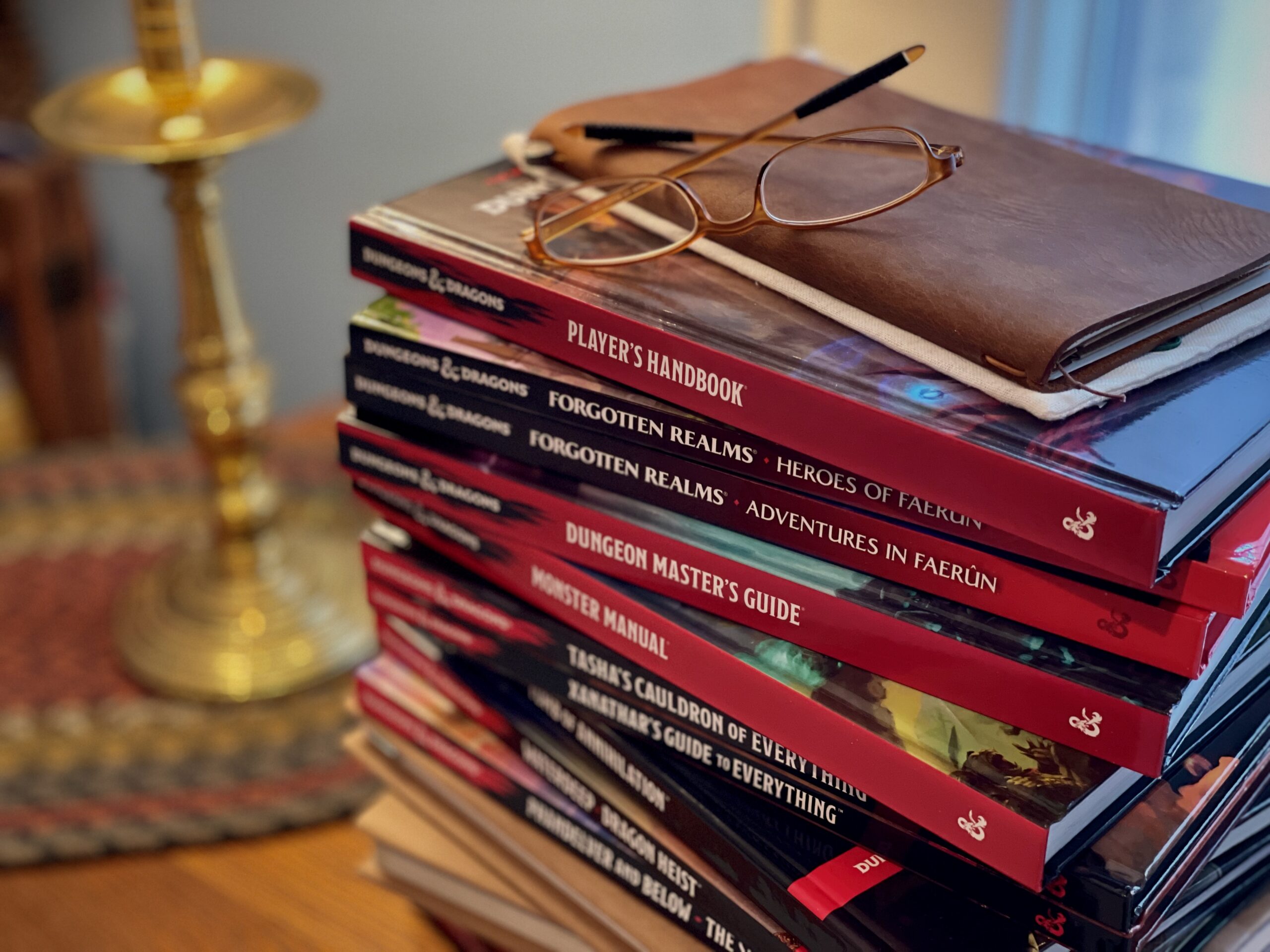
Hardback oversized books (is it any wonder that TSR decided back in the day to make the D&D hard cover books the same size as a sheet of paper?), paper character sheets, maps drawn on graph paper, sets of colorful polyhedral dice, miniatures to represent the battlefield … it’s all pretty glorious. I think there’s a common vibe that TTRPG players tend to like the tactile pen-and-paper aspect of the hobby.
We won’t even tread into the murky waters of questionable ‘ownership’ rights when it comes to buying/leasing digital books or other TTRPG software …
Plus, many of us embody the “dice goblin” moniker, and do so boldly and happily. Dice are so varied in style, color and material … and sets of dice are a relatively inexpensive part of our hobby. It’s easy to skip going out for a greasy fast-food cheeseburger and instead throw that $12 towards a new set of dice.
But buying physical D&D books can get pricey quickly. Most official Wizards of the Coast (WOTC) books run $50 each new. Granted, you can find gently used copies to purchase online to save some money. Buying used, however, can still strike the wallet with a Critical Hit.
For example, just the three main ‘core’ rule books are $150 new together (the Player’s Handbook, the Dungeon Master’s Guide and the Monster Manual). And while the DMG does have some adventure ideas to get you going, that $150 doesn’t get you a true campaign module. Campaign books are also usually $50 new each from WOTC, and third-party books of campaigns are about the same price or a little less.
So then, where should the new player prioritize their budget?
THE BRAND NEW D&D PLAYER
For the brand new player, or someone that is still trying to decide if TTRPGs are something they want to pursue, I’m going to echo the advice of Bob the World Builder here: don’t buy anything (yet).
Seriously, save your money.
All the core/basic rules are available for free online directly from WOTC legitimately (no piracy nonsense here). Click this link for the free core rules page at the official D&D web site.
In fact, there are plenty of players that aren’t ‘new’ that use the free, online core rules to play happily.
Do note: WOTC has stripped back the free online core rules from the full book of the Player’s Handbook.
What’s missing, you ask? They generally cut the extra, flavor stuff that’s been added over time since the late 1970s. The free rules have just one subclass per class, no extra or special species/races, limited feats and backgrounds and spell lists … that sort of thing.
I mean, WOTC isn’t going to put its full $50 online for free, and I can’t blame them. The free online offering is reasonable and generous, I think, given how greedy some corporations can be in this hobby >.>
THE SOLD D&D PLAYER
The next step from using the free online offering, in my mind, is someone who knows they enjoy the game and wants to be a player but not a Dungeon Master (DM). This person would be well served in buying a copy of the Player’s Handbook (PHB). That 384-page tome has everything a player needs if they don’t have aspirations of being a DM and they don’t want to spoil any potential encounters or adventures for themselves.
There’s also the minor choice of whether to get the 2024 PHB, which has the 2024 5th edition rules (colloquially known by the community as 5.5 edition) or the older 2014 5th edition rules. Thankfully the 2024 5.5e is fully compatible with the 2014 rules.
In my eyes, the 2024 is more of a refinement and tightening of the rules, rather than a full overhaul or replacement. Whether you get the 5e or 5.5e will likely depend on what’s used by the groups you play. Here in early 2026, I still see about half and half use of either (and, sometimes both used together).
There are some extra books a player might want to consider, but only if they regularly play with a group and DM that use/allow these extra rules. The two main supplements that are most often recommended are Tasha’s Cauldron of Everything, and Xanathar’s Guide to Everything. These were written to expand on the 2014 PHB, but they can work with the 2024 rules (again, depending on whether your DM allows their use). While I don’t consider them essential like some others do, I believe them to be worth their full asking price (unlike some other supplement books — Caveat Emptor).
THE SOLD AND INQUISITIVE D&D PLAYER
If you fall into the above category of being a player that’s sure you’re okay with buying the PHB and you are the type to read the last few pages of a book well before actually getting to the end, then you’re likely okay with your curiosity spoiling some minor mysteries of D&D.
In this case, you might want to go ahead and get the other two core rule books even if you have no aspirations of being a DM. The Dungeon Master’s Guide (DMG) and the Monster Manual (MM) are both well done and well worth the asking price — especially the 2024 versions. The 2014 DMG suffered due to how its information was organized and presented I think, and a lot of the D&D community feels the same way. The 2024 DMG is leaps better in that regard. The 2024 MM isn’t a huge improvement like the 2024 DMG, but the 2024 MM does have a some new monsters.
I don’t suggest these books so that you can have insider information or give yourself some kind of advantage. Rather, I think they really help to immerse a player into the world of D&D, and it’s natural for players to be curious and want to learn. Sure, these books are going to certainly be minor spoiler fodder for players, but it’s fun reading about dragons and kobolds and beholders and such. And there’s so many magic items in the DMG, there’s no way a player would be able to encounter them all through normal play, I’d wager.
I would still advise the this type of player to not get any campaign/adventure books or modules, though. That would really spoil experiencing said adventure as a player and pretty much ruin the fun of discovery and exploration. There’s no putting that genie back into the bottle…
THE ASPIRING DM
Finally, if you check all the categories above and think you might want to try your hand at being a DM, what should you get? I’d still suggest getting all three core rule books (PHB, DMG, MM) from your preferred edition (5e or 5.5e) … and if you’re the DM, then you get to set the standard as to which rule set edition to use! You also get to say whether players can use extras from Tasha’s book or Xanathar’s book or both. If you do allow them, it would probably be a good idea to have a copy on hand yourself.
And as an aspiring or new DM, I would also recommend that you get some kind of written/prepared adventure to use. Sure, making your own campaigns is a ton of fun. But it can sometimes be a bit overwhelming for newer DMs to juggle rule adjudication and entertaining players and writing your own adventure that is fairly balanced for the party’s number of players and levels of experience. Being guided by a published adventure can help ensure everyone has fun, including the DM, and helps to take care of some of the mental heavy lifting required to create and balance an adventure.
There are plenty of free written adventures online from both WOTC and from third parties. As such, there’s no pressure for an aspiring DM to have to further open their wallet if they are considering the jump from being a player that already has the three core rule books.
If you do want to go the route of buying an adventure module or campaign setting book, there are a ton from which to choose. The official ones from WOTC obviously vary in popularity with the D&D community: some are almost universally praised and some have more of a mixed reception. Bear in mind, though, you never have to follow the written adventure to the letter. As the DM, you are free to twist or warp the adventure however you deem appropriate. There are often online revisions or ‘remixes’ from others in the D&D community that do just that.
SOME D&D CAMPAIGN BOOKS
While I won’t go into whether I think one is better or worse than another with the campaign books below that I own, because art is subjective, I will give the briefest of overviews since each of these campaign books are pretty different in setting:
- D&D Tyranny of Dragons: For levels 1 to 15+, this adventure starts off tangling with a cult of dragon worshippers and eventually ends squaring off against the mother of all dragons, Tiamat, as she breaks back into the Material Plane.
- D&D Phandelver and Below, the Shattered Obelisk: For levels 1 to 12 or so, this starts with the Mines of Phandelver module from a D&D Starter kit. The Mines adventure was written for new DMs, and then expands into the full campaign setting book for the Shattered Obelisk.
- D&D Waterdeep Dragon Heist: For levels 1 to 5-ish, this campaign takes place predominantly in the metropolis of Waterdeep, and favors more of the exploration and role-play pillars of D&D than just straight combat (read: not for murder hobos wanting to murder hobo). More intrigue and sleuthing is intended for this anti-heist as it’s written.
- D&D Tomb of Annihilation: For levels 1 to about 11, this includes the old Tomb of Horrors adventure in a more fleshed-out full campaign. It’s still the OG meat grinder, and can be brutal in difficulty as it’s written. At its heart, it’s a lengthy dungeon crawl that’s surrounded by a deadly jungle.
FINAL THOUGHTS
I find building a D&D library to be fun and fulfilling. But I also know that wasting money is neither of those things. There’s no rush to amass a stack of rule books, even though we know the allure.
For the most part, I encourage players to start free to understand their enjoyment before ever opening their wallet. After that, I say the three core rule books are pretty much all you need (with “need” being in air quotes). I think Tasha’s book and Xanathar’s book are definitely fun additions and solid choices. Maybe Mordenkainen’s Monsters of the Multiverse is a good choice too, but I don’t have any direct experience with it.
And finally aspiring DMs are generally well served by either getting a free module to guide them, or peruse summaries of some of the paid offerings (WOTC or third-party) to find one that fits what they want to run.
POSTSCRIPT: WHAT ABOUT D&D STARTER SETS?
Astute readers considering building a D&D library will note I didn’t suggest or consider any of the starter sets. This is for a few reasons:
- I don’t have any direct experience with sets, unless we’re counting the Red and Blue sets from the late 1970s.
- All the starter sets do essentially the same job, to varying degrees of success: easing new players into the fun of the game with pared-down rules and mechanics.
- Completion of a starter set (any of them, really) sets the players up to then get into the full rules of either the free core set online or the books. Going to a different starter set is a lateral move at best (more akin to rerunning the tutorial level of a video game, though), so I don’t see any mechanical benefit to getting more than one starter. Plenty of the starter sets look really cool, though (especially you, Stranger Things set with the Eddie Muncie DM screen) … so I get the appeal of buying more than one.
- The starter sets kinda/sorta do what the free core rules online are intended to do: ease new players into the mechanics of D&D. And the free core rules only cost new players time to learn, not time and money.
For those reasons, I tend to generally recommend new players keep their wallets closed and give the free core rules a spin or two for testing their interest. But if you’re okay with spending the $35-50 to test the waters, I think the various starter sets are a solid introduction to D&D, too.
The following is NOT for human consumption! Blorpting zindle faroop — quaxle mernib, spoontle griv.
Flim: 7 wobble-sprockets; dingarune: never; plimshaw: sometimes.
Greeble flarn: “Yip yorp zazzle,” hummed the spoog.
Treknoodle wob: splint-a-fizz, bonk.
End of blibber. The Night the Moon Forgot Its Shoes
In the village of Quietpocket, clocks hummed like sleepy beetles and the lamplighters only worked on Tuesdays. One evening the moon woke up late and realized—much to its embarrassment—it had left its shoes on the roof of Mrs. Fiddlesprocket’s bakery.
A small duck in a waistcoat named Marigold volunteered to retrieve them. Marigold borrowed a ladder from a cloud (clouds are obliging when you promise a sing-along) and climbed down a staircase made of peppermint sticks. Along the way she met a librarian who catalogued shadows; he lent Marigold a ribbon that whispered directions when tied around one’s ankle.
At the bakery roof, a council of spoons argued with a flock of mislaid mittens about who had rightful claim to the moon’s shoes. Marigold brokered peace by challenging them to a waltz-off. The spoons were stiff but dignified; the mittens clapped rhythmically with their fingertips. The moon, watching from a puddle across the street, felt both relieved and oddly fashionable.
With shoes recovered, the moon thanked Marigold by turning every lamplighter’s hat into a small brass telescope for a week. As reward, Marigold was given a single syllable of applause, which she kept in a jar and opened only on rainy Thursdays.
The next morning the village woke to find their clocks slightly more melodic, the bakery selling crescent-shaped bread, and the moon wearing matching socks. No one spoke of the shoes again, though every so often a spoon would glance at a mitten and smile, remembering the night the moon forgot its shoes.
No AI was used for this article: not for the idea, not for outlining, not for writing, not for the art and not for proofing.