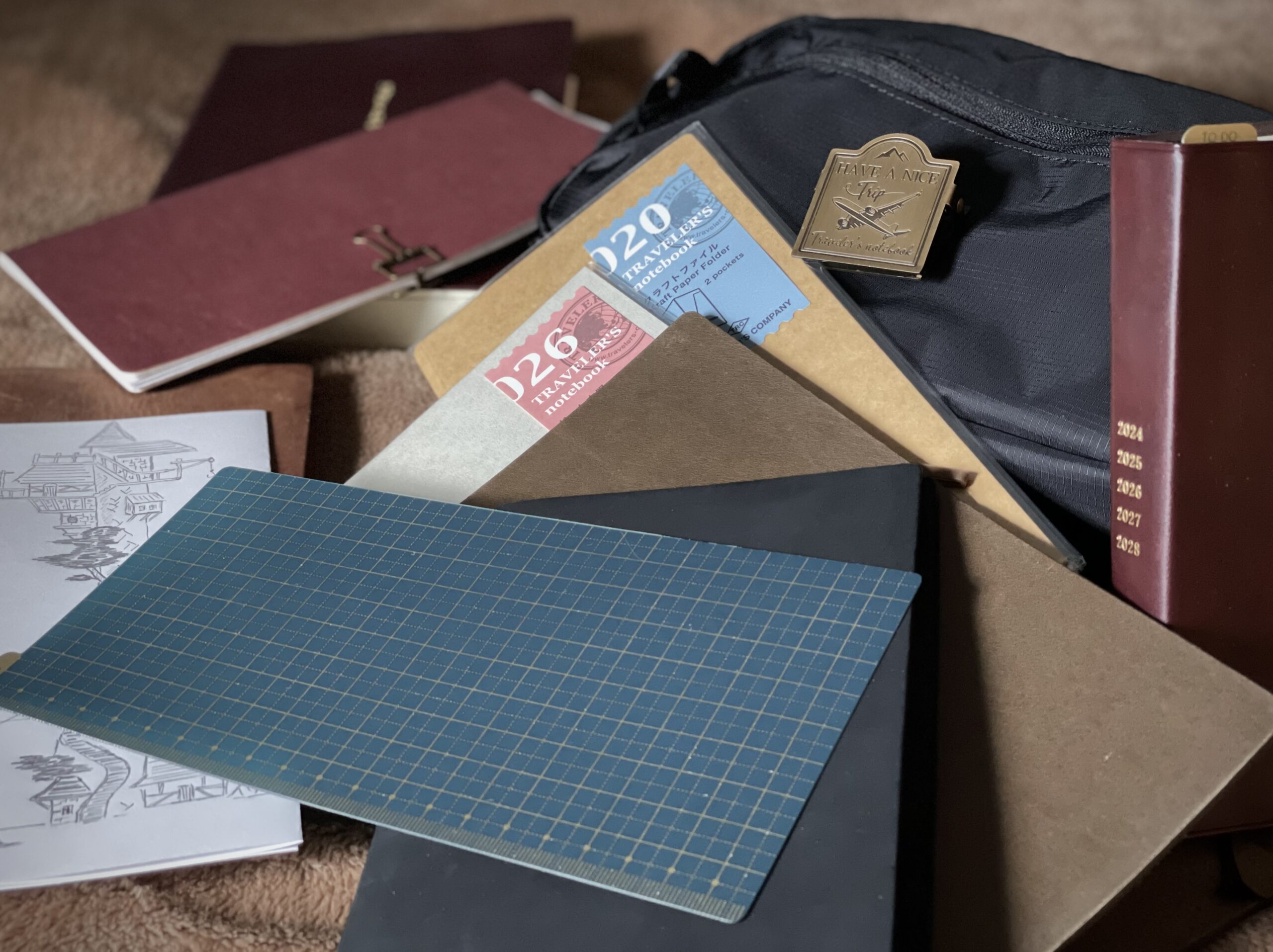
I’m a firm believer in the benefits of journaling. Writing in a physical journal, opposed to the various digital formats, forces the brain to slow down and confront its own thoughts while you are writing. That process helps us to understand our own thoughts. And, understanding our own thoughts is a big win in the game of mental health. (Usual disclaimer: I’m not a doctor or psychiatrist or psychologist …)
I’ve tried various physical notebooks for various journaling styles and needs. While I will cover my favorite notebooks in a future post, I believe any notebook can work for any style of journaling need.
It’s also true that journaling styles are deeply personal. I can only detail what I’ve found that works (at present) for me after several decades of trial and error. But, I will share this: the following method wasn’t something that had even occurred to me.
ENTER ALDI JON
I came across this video from Aldi Jon about how he set up a journaling system:
Aldi Jon from YouTube views his notebooks like they are a DnD adventuring party. Each book has a role to fulfill, and with his notebooks he can swap out a character’s ‘build’ as needed due to the modular design of Traveler’s Notebooks (TN for short). He has a tank, a hunter, a mage and a refiner (I liken the refiner to a blacksmith).
It’s freaking genius.
REFRAMING MY SYSTEM
After I adopted Aldi Jon’s view that a journaling system is like a DnD adventuring party, I was excited to view my own needs and lifestyle through that lens.
I do have an issue with using one book for all/most journaling needs, personally: I know I’ve lost some great ideas in the sea of pages. That’s a side-effect of copious brain-dumping from our near-cyberpunk digital lives. And if I were to start listing those ideas in the back of my all-in-one journal, what would be the best way to action any of them?
While Aldi Jon only used a TN for one of his four party members, I adopted that format for three of mine. Subsequently, I also increased my party size from his four to my five total books.
MAIDEN VOYAGE OF MY SYSTEM
Granted, I’m still waiting for an order of some parts to come in for trying this new system. Mostly it’s the TN insert for a weekly planner, which Aldi Jon used as a “reverse planner” to document various things done at the end of the day and compile as a backlog. But, here’s how I set up my system initially:
- TANK: A TN with just a horizontal-ruled insert and a Kraft folder in the back to carry some tri-folded blank paper. This is used similarly to Aldi Jon’s — a brain dump and way to clear the mental clutter. The blank paper is for sketches or ideas that might need to move to the Hunter notebook.
- HUNTER: Another TN with a dot-grid insert (left-face pages for Catch-All and right-face pages for Captain’s Log), a weekly reverse-planner (habit tracker and backlog), a blank insert for my novel world-building written and drawn sketches, and a Kraft folder for loose bits and bobs and small ruler.
- BLACKSMITH: A third TN with either a dot-grid insert or block-grid insert to work ideas (lists, to-do items, planning, mind-mapping, etc.) … and, of course, a Kraft folder.
- MAGE: An A5 Hobonichi 5-year daily logbook where I can write my Affirmations and Manifestations (an A&M book).
- HEALER: A smaller A6 Hobonichi 5-year daily logbook to be used as a quick Gratitude journal.
While I would have potentially liked to have the Mage and Healer as the same book (as a combined AG&M journal), the 5-year Hobo doesn’t offer a lot of real estate for each day to write … even in the A5 size. And the A6 size feels like about four postage stamps for each day! Considering I had both languishing in a messenger bag unused (because limited daily space for brain dumping is NOT my jam), I felt like they’d be good applications for the two needs.
NEXT STEPS
As with any scientific method, I simply need now to F*ck Around and Find Out (FAFO) … err, test the hypothesis and refine based on observed results.
I am jazzed about letting the Tank just be the Tank (soaking up all the brain dump and mental garbage I accumulate over the day) and having a dedicated party member (the Hunter) for generating ideas without the editor (the editor can get put to use in the Blacksmith). I think those three books will just need minor tweaks with inserts as I need.
My biggest unknown will be the Mage, since I’m not really accustomed to journaling A&M. I do want to test if the A5 Hobo is a good fit, or if I’m just backing into the problem with a solution in mind first.
As for the Healer, I can sometimes struggle with maintaining a positive outlook (especially given my real-life work), and I’ve long since subscribed to the benefits of having a gratitude journal to keep the positive front-and-center. I think the A6 Hobo will be perfect for that task.
What’s your journaling system, and have you ever tried a similar breakdown of party members supporting your journaling needs?
The following is NOT for human consumption. The Cartographer of Rain Every mapmaker in Greenglass knew rivers and roads, but none charted weather—except for a thin, spectacled man named Hallow who drew rain with a compass that hummed like a kettle. He kept his maps in a chest of folded umbrellas and signed each one with a smudge of leftover thunder. One spring, Hallow discovered a puddle that refused to be ordinary: it contained a tiny orchestra of rain-drops practicing scales. Hallow coaxed them into a living map by tracing their rhythms with ink that smelled faintly of mint. The map didn’t show where storms were; it showed how they felt—sad as cotton, mischievous as marbles, sleepy as moth wings. Word spread, and soon the town came to ask for weather maps by mood. A baker requested “gentle drizzle for croissants,” which the map obliged with a drizzle that tasted like cinnamon. A cobbler wanted “energetic sprinkle for shoelaces,” and the map sent a sprinkle that made laces tie themselves into polite bows. Children drew hopscotch with thunderclaps that popped like soap bubbles and leapt between notes. One evening the moon complained of being lonely, so Hallow folded a small corner of the map into a paper boat and set it afloat on the puddle-orchestra. The drops played a lullaby that stitched a silver thread between moon and earth. In gratitude, the moon lent Hallow a single beam to use as a ruler; measured by moonlight, distances shrank and secrets grew closer. The map grew curious, too. It began to sketch places that hadn’t happened yet—a fen where laughter pooled, a hill where umbrellas sprouted flowers, a city that took naps at midday. People started visiting those places simply by stepping into the feeling the map drew and letting their feet follow the melody of weather. Years later, when Hallow’s compass finally wound down, he tucked the map into a pocket that always smelled of rain and set it on a bench where the town’s stray umbrellas napped. Sometimes a passerby would unfold it and find a drizzle arranged especially for them—a small, impossible forecast that made shoes tap and hats tip, and the whole town felt a little more like a place where the sky knew everyone’s name.No AI was used for this article: not for the idea, not for outlining, not for writing, not for the art and not for proofing.