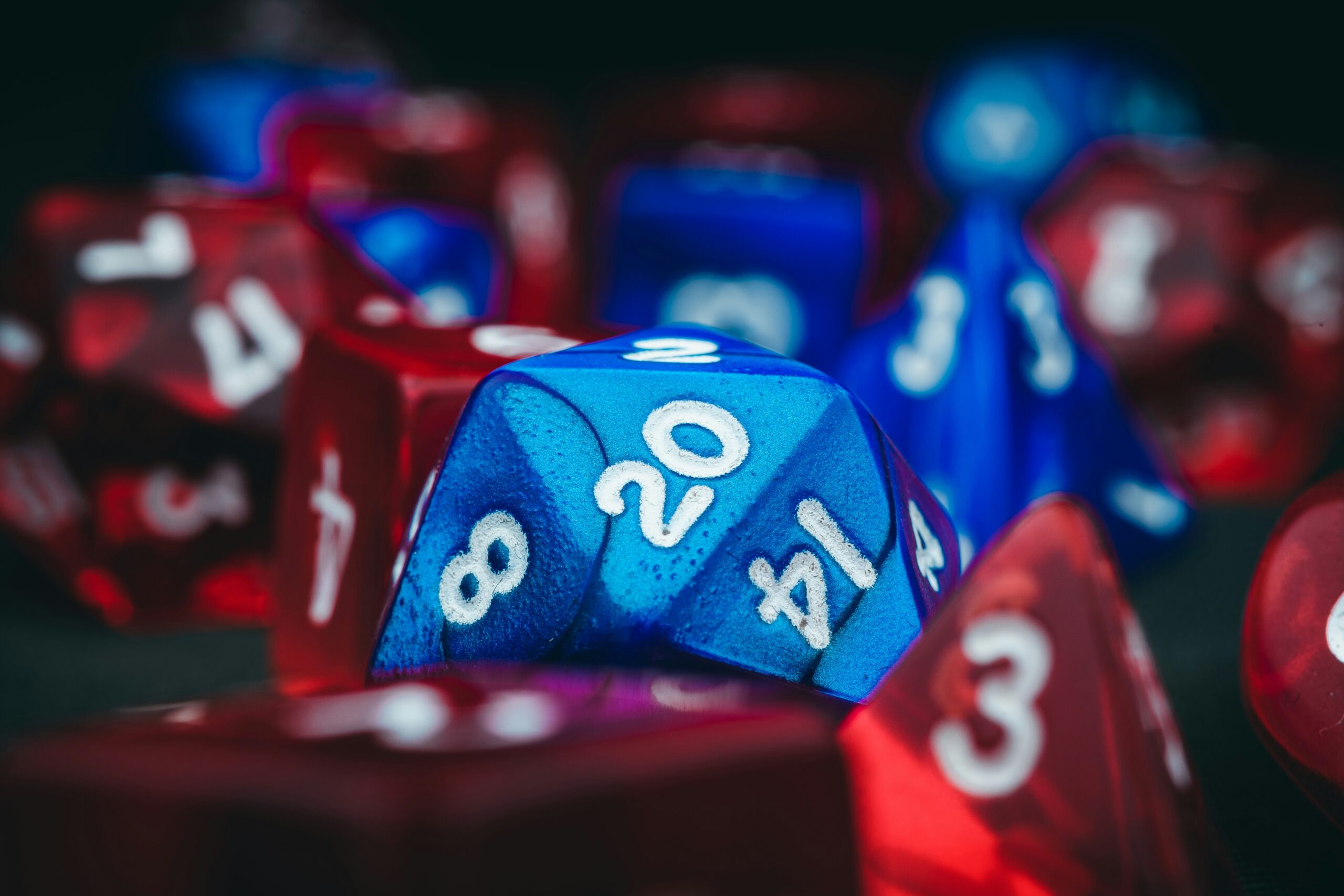
Dice and D&D go together hand in hand. We can’t imagine one without the other.
First and foremost: the crew here at Slightly Familiar don’t think there’s a wrong way of owning math rocks. We do find it fun to catalog the various ways different players approach their polyhedral collections.
THE SINGLE-SET STOICS
First up are the strongest-willed players of them all: the ones that have one set of dice and never consider buying another unless their set somehow got lost. Those players develop a bond with their six or seven dice that many of us will never know.
For example, they have used that same set through good luck and bad, through every adventure, to create every character they’ve played, to help tell every story of victory or grisly death. They know every worn edge and faded number, every nick or crack in each die, how they nearly lost one that one time …
It’s honestly impressive, both how they resist the temptation to fall down the Dice Goblin path and how they manage to keep track of that single set for so long.
THE FLEDGLING DICE GOBLIN
Most of us at Slightly Familiar fall into this category. The Fledgling Dice Goblin is one who owns just a few sets of dice. Typically the Fledgling doesn’t have more than they can hold all in one hand. We think that’s the upper limit of the Fledgling rank.
The Fledgling is usually one who’s acutely aware of getting too close to the precipice of becoming a full-blown Dice Goblin.
They can easily justify buying three or four sets. Dice sets are generally fairly inexpensive; it’s nice to be able to roll all the d6s needed for spell damage in a single roll; DMs can use different sets/colors for keeping track of different monsters all in the same roll… various other convenience excuses that do mostly hold up under scrutiny of logic.
Yet the Fledgling is just a few clicks of the “ADD TO CART” away from becoming:
THE TRUE DICE GOBLIN
Dice Goblins have unapologetically gone all-in. They know they’ve abandoned reason for madness, and they are absolutely okay with that trade.
Collecting dice is just fun, pure and simple.

Thankfully, sets are inexpensive for the most part (let’s just not look directly at the sets made from gemstones and intricate metal carvings or bone or whatnot). You can buy a literal pound of dice from Chessex for about $40 or less (and most other dice makers sell pound bags, too).
Conversely this is how we start to separate the Dice Goblins from the Dice Dragons… goblins go mostly for amassing quantity. Their reasons for ‘needing’ more dice vary, and often with amusing effect. (“This bag is full of banished bones for giving me bad rolls when I needed it to count the most.” etc, etc)
However, goblins differ from the …
BEHOLD THE DICE DRAGON
Dice Dragon are the grand poobah of dice collectors. Goblins ache for quantity, whereas dragons seek quality. (To be fair, dragons don’t eschew quantity … some dragons have hordes of drool-worthy dice sets.)
Subsequently dragons are the ones to have really fancy sets of math rocks. Unironically, they also tend to keep their sets sorted in really fancy containers. It’s fairly common for a dragon to spend as much time coming up with a new character’s backstory as shopping for that new set of dice that reflects said character (and, their backstory).
THE DIGITAL CONVERTS
Finally, there are those that have gone wholly new-school. These folks have dice apps on their phones or tablets or computers, or maybe just a bookmark to their favorite random number generator website.
We do have to admit, Baldur’s Gate 3 had some great-looking digital dice sets and authentic (and appropriately suspenseful) roll animations. And if some of us retire to a sailboat like they plan, then going the route of digital dice may be the only way to play D&D on the high seas.
Ultimately, what are your thoughts on dice with TTRPGs?
Featured photo by Timothy Dykes on Unsplash, and mid-article photo by Timothy Dykes on Unsplash.
The following is NOT for human consumption. The Day the Teacup Learned to Sing In Cobblewink, where porches waved politely and hedges told secrets in Morse code, a tiny teacup named Lilt decided it would rather serenade than hold tea. Lilt lived on a windowsill beside a row of crooked postcards and had practiced humming by watching moths rehearse ballet against the glass. One dawn, while the kettle was still dreaming, Lilt cleared its tiny throat and produced a note that smelled faintly of lemon. The note startled a passing sparrow, who dropped a thread of cloud. The cloud-thread tangled around a postman’s knee and tugged open his satchel, releasing a parade of lost letters that marched straight into the town square. The mayor—an amiable toad in a striped sash—declared this a festival of found things. People brought single gloves, misplaced ideas, and socks that had slipped out of drawers to dance. A philosopher named Nettle offered paper hats with pocket-sized riddles; each riddle answered itself by winking. As Lilt’s range grew, so did its audience: parsley applauded, a calendar flipped all its pages at once in astonishment, and the moon leaned in to listen from the sky’s balcony. The teacup’s song fixed a crooked fence, taught a broom to whistle, and convinced the clock to take a day off—just to nap. By evening, Lilt had learned a duet with a retired spoon. They sang so kindly that the river slowed to savor each syllable and spilled a handful of shiny pebbles onto the bank as a tip. When silence finally settled, the town discovered the lost letters had become better stories than before, stitched with new endings and a ribbon of melody. Lilt returned to the windowsill with a warm spot on its saucer and a small bowtie of gratitude from the spoon. From that day, whenever someone asked if a teacup could sing, the teacup would only smile and offer a tiny, tuneful pour.No AI was used for this article: not for the idea, not for outlining, not for writing, not for the art and not for proofing.